

How do used EVs hold up?
Many factors influence EV longevity. Here, CarMax experts explore key factors, common concerns, and provide insights to help you make informed decisions about buying and maintaining a used electric vehicle.
How do EV batteries change over time?
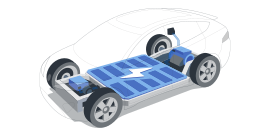
All batteries experience some degradation over time—that’s normal. This means that as your battery ages, it won’t hold as much charge as it once did, and you’ll notice reduced range, meaning you can’t go as far on a single charge.
Our partners at Recurrent monitor electric vehicle battery longevity and have helpful overviews of how different vehicles perform.
Battery life depends on many things including the make and model of the car, how the car is used, the condition and maintenance of the vehicle, plus things like temperature, where the vehicle is located, and how frequently the battery is fully charged and discharged. See fueleconomy.gov for more info.
Understanding how age affects EVs
Just like in your smartphone, the lithium-ion battery in an electric car will eventually stop holding as much charge. But have you ever wondered why? And if there’s anything you can do to delay it?
Just like EVs are a little different to own, they're a little different to buy used, too. So before you make the plunge, check out our tips on what you need to know before signing on the dotted line.
What to look for when buying a used EV
Buying a used EV isn’t much different than buying a gas-powered car, you’ll still want the dealership to provide you with a vehicle history report and inspection.
Once you’ve handled the basics, here’s a list of five things to do when buying an EV for the first time:

The average American drives about 37 miles a day, according to the U.S. Department of Transportation. If you plan on charging at home daily, most fully electric vehicles provide plenty of range. But if you’ll be relying on public charging stations, you should find an EV that has enough range to last between your planned charging sessions.
To find out how much range a used EV provides, check the EPA's website. The EPA’s site allows you to compare different models, but keep in mind that some EVs have different battery pack sizes that provide different driving range.
The most convenient and affordable way is charging at home. Plugging into a regular 120-volt household outlet is known as Level 1 charging and adds about 3-5 miles of range per hour, while plugging into a larger 240-volt outlet, like the kind your clothes dryer uses, is known as Level 2 charging and adds about 10-20 miles per hour.
Read our article on everything you need to know about EV charging for the full rundown.
Some EVs display the battery's health on the instrument panel, but if that's not available, then ask the dealership to run a diagnostic test. You can also ask the seller to charge the EV to 100% and compare the indicated range on the instrument panel to the EPA-estimated range. If the numbers are close, the battery's health is likely OK, but if there’s a big gap, look for a different vehicle.
 EV batteries typically degrade 1% to 2% a year, according to Recurrent.
While most new electric vehicles come equipped with EV-specific tires, that might not be the case with a used vehicle if the tires have been replaced. (Most EV tires include "EV" or "electric" in the name.)
If the tires aren't designed for EVs, that's okay, but they could wear out faster because many EVs weigh more and usually have more power than comparable gas-powered vehicles. Such tires can also reduce range due to their lack of low rolling resistance.
FAQs about electrified vehicles
A variety of factors can contribute to the longevity of an electric vehicle's battery, though some contributors are age of the battery, temperature exposure over time, number of charging/discharging cycles, and times the battery has been fully discharged.
EV battery life depends on many things, including the make, model, use, condition, and maintenance of the vehicle. The battery will experience some degradation over time (just as internal combustion engines experience some degradation as they age); however, a majority of electrified vehicles on US roadways are younger than 8 years so we don’t yet fully know.
The US government mandates manufacturers provide warranties for the batteries in BEVs, PHEVs, and HEVs for 8 years or 100,000 miles, whichever happens first. You can read more on the EPA’s website.
We hope you found this information helpful. This content is intended to inform and is not meant to indicate that a particular vehicle is currently available or recommended for you.
Statements of fuel economy or EV range are based on EPA and other third-party estimates for vehicles when new. Fuel economy and EV range will degrade with time and vary based on age, driving conditions, vehicle history, and other conditions. See fueleconomy.gov for more info.
Editorial content contained on this page comes from Edmunds.com, Inc., a subsidiary of CarMax Enterprise Service, LLC, and information related to featured vehicles comes from third-party sources, including manufacturer information. Product and company names may be trademarks or registered trademarks of third-party entities. Use of them does not imply any affiliation with or endorsement by these entities. By clicking on any video links, you will be taken to a third-party site maintained by YouTube, Inc.
We make every effort to provide accurate information, but please verify before purchasing.