Understanding modern car technology
With thousands of vehicles in our inventory, we’re here to help make car research easier for you. We’ve partnered with car review experts from Edmunds to weigh in on what matters most when you’re looking to buy a truck or car.
***
Article Summary:
ADAS is not self-driving
Advanced driver-assist systems support the driver, warning you of hazards and stepping in during emergencies, but you’re still responsible for driving at all times.There are five main categories
Collision warning and braking, adaptive cruise control, lane assist, blind-spot monitoring, and driver attention monitors. Each have different levels of driver intervention.It’s becoming the safety standard
The IIHS found automatic emergency braking cuts rear-end collisions in half. Federal law now requires it on all new vehicles by 2029.The names are confusing, but the tech’s the same
Every automaker brands these systems differently. We’ll help you decode what Honda, Toyota, Ford, and others call the same features.
Have you recently looked at a newer used car, say, something made since about 2016? If so, you may have noticed a bewildering array of new features and abbreviations. Adaptive cruise control, lane-keeping assistance, driver attention warning, and an alphabet soup of acronyms like LDW, FCW, AEB, BLIS … the list goes on and on.
Collectively, these technologies are known as advanced driver-assist systems, or ADAS for short. Although many of the individual technologies have been around for nearly two decades, they once were exclusive to high-end luxury cars. Today, driver-assist tech is standard on most new vehicles and widely available on used cars made since the late 2010s, including both AWD and 4WD vehicles. Manufacturers often bundle them under a brand name, such as Honda Sensing®, Toyota Safety Sense Plus™, or Ford Co-Pilot360™.
Here’s everything you need to know about ADAS, from how it works to what to look for on your next used car.
What are Advanced Driver Assist Systems?
Advanced driver-assist systems, or ADAS, are designed to help drivers be aware of their surroundings and, in some cases, intervene to try to prevent or lessen the impact of a collision. Through the use of radar, cameras, and other sensors located strategically around the vehicle, ADAS can help inform drivers of things they may not be aware of, such as vehicles in their blind spot, a car slowing suddenly in front of them, or their own car drifting out of its lane.
While many of these technologies may seem new to used-car shoppers, the underlying tech has been around for a while. Many of the systems, such as forward collision warning and adaptive cruise control, have been around since the 2000s. What's new is how manufacturers are bundling the various technologies under a single banner and how commonplace these technologies have become, even on more budget-friendly vehicles.
Driver-assist systems are NOT the same as self-driving cars
The goal of ADAS is not to drive the car for you. That's what's known as "autonomous driving," where the car can drive itself without any input or attention from the driver. Right now there are no cars that offer fully autonomous, hands-off driving 100% of the time. Instead, the driver of an ADAS-equipped car is still responsible for driving but is given additional awareness of his or her surroundings—and more direct support in certain situations—through the use of technology. That means the vehicle will try to warn you of certain risks or dangers so that you can take action and will only directly intervene as a last resort. Remember, driver-assist systems are not a guarantee against collisions. Think of ADAS like a good pair of glasses, helping to bring the world into sharper focus.
Advanced driver-assist systems can have confusing names
Pop quiz: What's the difference between Collision Mitigation Braking System™, Intelligent Brake Assist, and City Safety™? The answer: nothing. These are all brand names given to automatic emergency braking systems by Honda, Nissan, and Volvo, respectively.
To help you navigate this unfortunately complicated web of names, we'll be providing a list of what each manufacturer calls its technology. However, these names sometimes change over time, so it's a good idea to check a manufacturer's website so you know what you're getting and to familiarize yourself with the systems on whatever car you purchase.
Five Broad Categories of Advanced Driver-Assist Systems
In this article we'll cover five major areas of advanced driver-assistance systems, grouped by their general function. These are:
Collision warning and braking: Includes forward collision warning and autonomous emergency braking.
Adaptive cruise control: Includes systems that can adjust speed while traveling at freeway speeds and those also capable of following low-speed traffic.
Lane assist systems: Includes lane departure warning and lane keeping assistance systems, which vary in intensity depending on the manufacturer.
Blind-spot warning: Modern versions often include rear cross-traffic warning and, more recently, reverse automatic emergency braking.
Driver attention monitors: Includes passive systems that monitor steering wheel inputs and active ones that use a camera to monitor the driver's face.
Here’s a breakdown of what each system does, at a glance:
ADAS System | What It Does | Warns You | Can Intervene | Typical Speed Range |
|---|---|---|---|---|
Forward Collision Warning (FCW) | Detects vehicles or pedestrians ahead | Yes | No | All speeds |
Automatic Emergency Braking (AEB) | Applies brakes to avoid or soften a collision | Yes | Yes | Low to highway speeds |
Adaptive Cruise Control (ACC) | Maintains following distance automatically | No | Yes | 25+ mph (low-speed follow on newer systems) |
Lane Departure Warning (LDW) | Alerts when you drift across lane markers | Yes | No | Highway (35+ mph) |
Lane Keeping Assistance (LKAS) | Steers car back into lane | Yes | Yes | Highway (35+ mph) |
Blind-Spot Monitor (BSM) | Detects vehicles in your blind spot | Yes | Sometimes | All speeds |
Rear Cross-Traffic Alert (RCTA) | Warns of approaching traffic when reversing | Yes | Sometimes | Low speed / reversing |
Driver Attention Monitor (DAM) | Detects drowsiness or inattention | Yes | Sometimes | Highway |
To be clear, there are a lot of other technologies that don't fit neatly into these categories. For example, some vehicles today include not just backup cameras but also surround-view cameras that give a complete view of the car's surroundings, making it easier to squeeze into tight parking spaces. Head-up displays project driving information like speed, navigation directions, and more on the windshield, helping drivers keep their eyes on the road. Other advances, like a continuously variable transmission (CVT), can also contribute to a smoother, more thrifty drive.
1. Forward Collision Warning and Automatic Emergency Braking
Mercedes-Benz was the first manufacturer to offer forward collision warning in the U.S. market way back in the 2000 model year. A few years later, Acura debuted the first automatic emergency braking (AEB) function for the 2006 model year. By 2023, 95% of new passenger cars sold in the U.S. had AEB, following a voluntary agreement brokered by the IIHS, Consumer Reports, and NHTSA. In 2024, NHTSA mandated all new passenger cars to have AEB as standard equipment by September 2029.
Forward collision warning (FCW) will warn the driver of an impending collision with another vehicle or, in the case of newer systems, pedestrians and bicyclists. The warning usually consists of some combination of a visual warning projected in front of the driver along with an audible alert. If the warning goes unheeded, automatic emergency braking—sometimes called autonomous emergency braking—will activate the brakes to slow the vehicle in an effort to either avoid a collision entirely or slow the car enough to lessen the impact.
How do forward collision warning and automatic emergency braking work?
Both forward collision warning and automatic emergency braking use the same sensors to monitor the road ahead, scanning for other vehicles or, in the case of newer systems, pedestrians and bicyclists. The sensors usually consist of a radar mounted on the front of the car and a camera system mounted high on the windshield. The system can use both the radar and camera in conjunction or, in some cases, just one or the other. If the system detects an object, it will alert the driver with a combination of audible and visual warnings—either a message on the dash or a visual warning projected on the windshield. The warnings are hard to miss and are intended to give the driver enough time to react.
However, in cases where the driver fails to respond, automatic emergency braking will kick in if the vehicle is equipped with it. This system applies the brakes in an attempt to bring the car to a full stop or slow the car enough to reduce the severity of an impact. Importantly, not all AEB systems work at all speeds, but nearly all of them work at low speeds, below 20 mph. That's still useful, though, such as when you're in slow-moving traffic or in parking lots.
Manufacturer names for forward collision warning
BMW, Mini:
Frontal Collision Warning
Forward Collision Warning
Approach Control Warning
Buick, Cadillac, Chevrolet, GMC:
Forward Collision Alert
Following Distance Indicator
Ford, Lincoln:
Pre-Collision Assist
Forward Collision Warning
Pre-Collision Assist Alert
Honda, Acura:
Forward Collision Warning
Hyundai, Kia, Genesis:
Forward Collision Warning
Forward Collision-Avoidance Assist
Land Rover, Jaguar:
Forward Alert
Mazda:
Smart City Brake Support
Forward Obstruction Warning
Mercedes-Benz:
Congestion Emergency Braking
Active Brake Assist
PRE-SAFE® Brake
Nissan, Infiniti, Mitsubishi:
Predictive Forward Collision Warning
Intelligent Forward Collision Warning
Forward Collision Mitigation
Rivian:
Forward Collision Warning
Alfa Romeo, Chrysler, Dodge, Fiat, Jeep, Maserati, Ram:
Full-Speed Forward Collision Warning-Plus
Forward Collision Warning
Full Speed Forward Collision Warn Plus
Subaru:
Pre-Collision Braking
Tesla:
Collision Warning
Forward Collision Warning
Toyota, Lexus:
Pre-Collision Warning
Pre-Collision System
Volvo, Polestar:
City Safety™ Collision Warning
City Safety™
Volkswagen, Audi, Porsche:
Audi Pre Sense® Front
Pre Sense® City
Porsche Active Safety
Forward Collision Warning (Front Assist)
Porsche Active Safe (PAS)
Front Assist
Manufacturer names for automatic emergency braking
BMW, Mini:
City Collision Mitigation
Emergency Braking
City Light Braking Function
Buick, Cadillac, Chevrolet, GMC:
Forward Automatic Braking
Automatic Emergency Braking
Enhanced Automatic Emergency Braking
Ford, Lincoln:
Automatic Emergency Braking (AEB)
Pre-Collision Assist
Active Braking
Honda, Acura:
Collision Mitigation Braking System
Hyundai, Kia, Genesis:
Automatic Emergency Braking
Forward Collision-Avoidance Assist
Land Rover, Jaguar:
Emergency Brake Assist/Emergency Braking
Autonomous Emergency Braking
Advanced Emergency Brake Assist
Mazda:
Smart City Brake Support
Advanced Smart City Brake Support
Mercedes-Benz:
Active Brake Assist
Nissan, Infiniti, Mitsubishi:
Forward Emergency Braking
Automatic Emergency Braking
Intelligent Emergency Braking
Rivian:
Automatic Emergency Braking
Alfa Romeo, Chrysler, Dodge, Fiat, Jeep, Maserati, Ram:
Active Braking
Forward Collision Warning With Mitigation
FCW With Mitigation Operation
Subaru:
Automatic Pre-Collision Braking System
Pre-Collision Braking
Tesla:
Emergency Braking
Automatic Emergency Braking
Toyota, Lexus:
Pre-Collision System
Volvo, Polestar:
City Safety™ auto brake
City Safety™
Volkswagen, Audi, Porsche:
Pre Sense® Front
Emergency Braking
Porsche Active Safety
Autonomous Emergency Braking
Porsche Active Safe (PAS) Brake Assist
Front Assist
2. Adaptive Cruise Control
If you've ever taken a road trip, you're probably familiar with cruise control. You're also probably familiar with how often you have to hit the little "plus" and "minus" controls to increase and decrease your speed to stay with the flow of traffic.
Adaptive cruise control (ACC), also known as active cruise control, eliminates the need for constant manual speed adjustments by monitoring the vehicle in front of you and automatically adjusting your vehicle's speed to match. Introduced in the early 2000s, it has since become standard on most new vehicles.
How does adaptive cruise control work?
Adaptive cruise control uses the same sensors as forward collision warning and automatic emergency braking, which is why they're often bundled together. To use it, simply set your speed as you would with regular cruise control and give that right foot a rest. A radar mounted on the front of the car, cameras on the windshield, or a combination of both monitors the road ahead and locks onto the vehicle in front of you, if there is one. If that car slows down, ACC senses this and slows your vehicle as well, maintaining the same speed and relative distance. When the car ahead of you speeds up, your car speeds up, back to the speed you initially set.
When it was introduced in the early 2000s, ACC usually only operated at highway speeds, automatically shutting off below about 25 mph. Since gaining popularity in the mid-2010s, newer systems often include a feature called "low-speed follow," or something similar. This allows the system to bring the car to a complete halt and resume again once traffic starts flowing. If that sounds like it'd be handy during your traffic-heavy commute, you're right.
You can also adjust your following distance. Although no system will let you tailgate, you can be closer or farther away from the car in front of you, depending on your own comfort level. Just note that the closer you are, the faster the system will have to react to changes in speed. This can result in more abrupt-feeling transitions between cruising and braking.
Manufacturer names for adaptive cruise control
BMW, Mini:
Dynamic Cruise Control
Active Cruise Control
Distance Control
Buick, Cadillac, Chevrolet, GMC:
Adaptive Cruise Control
Ford, Lincoln:
Adaptive Cruise Control
Intelligent Adaptive Cruise Control
Honda, Acura:
Adaptive Cruise Control
Adaptive Cruise Control with Low-Speed Follow
Hyundai, Kia, Genesis:
Smart Cruise Control
Advanced Smart Cruise Control
Land Rover, Jaguar:
Adaptive Cruise Control
Mazda:
Mazda Radar Cruise Control
Mercedes-Benz:
Active Distance Assist DISTRONIC®
Nissan, Infiniti, Mitsubishi:
Intelligent Cruise Control
Rivian:
Adaptive Cruise Control
Alfa Romeo, Chrysler, Dodge, Fiat, Jeep, Maserati, Ram:
Adaptive Cruise Control
Subaru:
Advanced Adaptive Cruise Control
Tesla:
Traffic-Aware Cruise Control
Toyota, Lexus:
Dynamic Radar Cruise Control
Volvo, Polestar:
Adaptive Cruise Control
Volkswagen, Audi, Porsche:
Audi Adaptive Cruise Assist
Adaptive Cruise Control
3. Lane Departure Warning and Lane Keeping Assistance
Even the most attentive drivers can sometimes lose focus, and when that happens your vehicle may drift over the lines on the road into an adjacent lane. That's where lane departure warning (LDW) comes into play. Newer vehicles add another level known as a lane keeping assistance system (LKAS) that will actually gently nudge the car back into its correct lane.
Introduced to the U.S. market in the mid-2000s, these systems have seen widespread adoption across all levels of the automotive industry, and today lane departure warning is standard equipment on virtually all new vehicles, alongside forward collision warning and automatic emergency braking.
How do lane departure warning and lane keeping assistance systems work?
Both lane departure warning and lane keeping assistance use the camera system we've previously mentioned that's used on forward collision warning and adaptive cruise control systems. The images from these cameras are processed by sophisticated computers programmed with object and pattern recognition software, allowing the vehicle to "see" the lines on the road.
Lane departure warning monitors the road for the lane markers on either side of the vehicle. If the car begins to drift over a lane marker without the turn signal indicating an intentional lane change, the system will alert the driver, often with a tone or a vibration through the steering wheel. Some cars built by General Motors (Chevrolet, GMC, Cadillac, and Buick) use a vibration in the driver's seat, with the left side of the seat cushion vibrating if the vehicle is drifting left or the right side if it's drifting right.
Lane keeping assistance takes it to the next level. In this case, the vehicle doesn't just warn the driver; it actively adjusts the steering, gently nudging the car back into its own lane. LKAS is often strong enough that the driver can feel the steering wheel turn slightly on its own when on the highway, which can help reduce driver fatigue over long distances.
As computer and sensory technology have improved over the years, LDW and LKAS have gotten more sophisticated. However, there are still limitations. Both LDW and LKAS commonly only work at highway speeds, above 35 mph, although some newer systems can also work in traffic at low speeds. The systems need clearly marked lines on the road, and they can sometimes be confused by things like long tar strips, seams in concrete, or other linear patterns. Still, both are useful technologies and easy to find on recent cars.
Manufacturer names for lane departure warning
BMW, Mini:
Lane Departure Warning
Buick, Cadillac, Chevrolet, GMC:
Lane Keep Assist
Ford, Lincoln:
Lane-Keeping Assist
Lane-Keeping Alert
Honda, Acura:
Road Departure Mitigation
Hyundai, Kia, Genesis:
Lane Keeping Assist
Land Rover, Jaguar:
Lane Keep Assist
Mazda:
Lane-keep Assist System (LAS)
Lane Departure Warning System
Mercedes-Benz:
Active Lane Keeping Assist
Nissan, Infiniti, Mitsubishi:
Lane Departure Prevention
Intelligent Lane Intervention
Rivian:
Lane Departure Warning
Alfa Romeo, Chrysler, Dodge, Fiat, Jeep, Maserati, Ram:
LaneSense® Lane Departure Warning
Subaru:
Lane Keeping Assist
Lane Departure Prevention Function
Tesla:
Lane Keeping
Lane Departure Avoidance
Lane Assist
Toyota, Lexus:
LDW with Steering Assist
Road Edge Detection
Lane Departure Alert with steering control
Volvo, Polestar:
Lane Keeping Aid
Volkswagen, Audi, Porsche:
Lane Assist
Lane Departure Warning
Manufacturer names for lane keeping assistance
BMW, Mini:
Lane Keeping Assistant
Side Collision Avoidance
Steering Intervention
Buick, Cadillac, Chevrolet, GMC:
Lane Keep Assist
Ford, Lincoln:
Lane-Keeping System
Lane-Keeping Aid
Honda, Acura:
Lane Keeping Assist System
Hyundai, Kia, Genesis:
Lane Keeping Assist
Lane Safety Assist
Land Rover, Jaguar:
Lane Keep Assist
Mazda:
Lane-Keep Assist
Mercedes-Benz:
Active Lane Keeping Assist
Nissan, Infiniti, Mitsubishi:
Lane Departure Prevention
Intelligent Lane Intervention
Rivian:
Lane Keep Assistance
Alfa Romeo, Chrysler, Dodge, Fiat, Jeep, Maserati, Ram:
LaneSense®
Active Lane Management
Lane Keeping Assist
Subaru:
EyeSight® Lane Keep Assist
Tesla:
Lane Keeping
Lane Departure Avoidance
Lane Assist
Toyota, Lexus:
Lane Departure Alert with steering control
Lane Tracing Assist
Volvo, Polestar:
Lane Keeping Aid
Volkswagen, Audi, Porsche:
Audi Active Lane Assist
Lane Keep Assist
Lane Assist/Lane Keeping System
4. Blind-Spot Monitor and Rear Cross-Traffic Alert
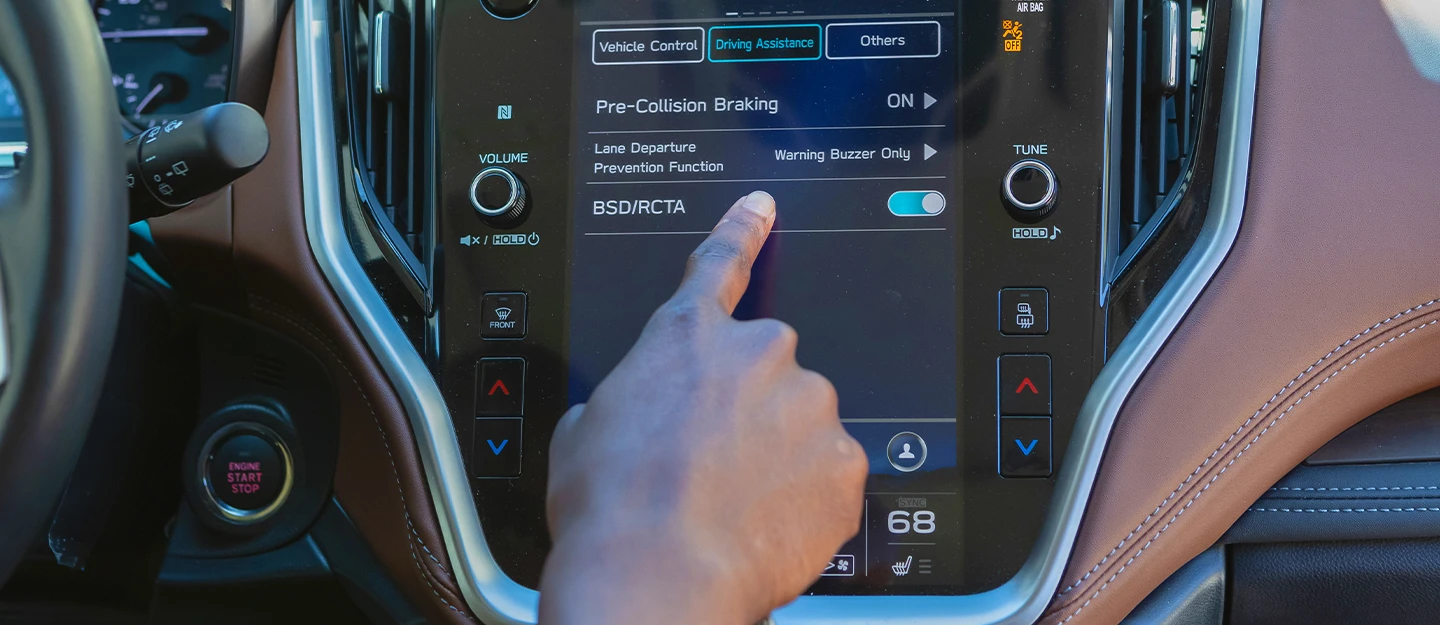
At first glance, blind-spot monitoring systems (BSM, also known as blind-spot information systems, or BLIS, or blind-spot warning) and rear cross-traffic alert systems (RCTA, sometimes called rear cross-traffic warning) would seem to have very different functions. However, they use the same basic set of sensors, so they usually come as a package.
Blind-spot monitors were introduced in the late 2000s and quickly became popular with luxury and then mainstream manufacturers. It's still not usually found as standard equipment on base trims, but even entry-level models generally include it on some trim levels these days. Since the mid-2010s, BSM has become available on virtually any vehicle type or class.
Rear cross-traffic alert builds on BLIS by using the same sensors to warn the driver if there are vehicles approaching from the side when backing up. More modern systems often pair RCTA with a rear automatic emergency braking system as well.
How do blind-spot monitoring and rear cross-traffic alert work?
Both blind-spot monitoring and rear cross-traffic alert use radar mounted in the rear of the vehicle, usually with separate units on either side of the rear bumper. These radar units constantly monitor traffic behind the vehicle. If an adjacent car is in or approaching your blind spot, a warning light appears near the side-view mirror, often on the mirror itself. If the driver uses the turn signal to indicate a lane change when there is a vehicle in the blind spot, a warning will usually sound to alert the driver. Some newer systems even include intervention technology that will try to prevent the driver from changing lanes if there is a potential for a collision.
Building on this technology, RCTA uses the same radar sensors to scan behind the car when reversing. Coupled with a backup camera, the system will alert the driver of cross traffic with a tone and an arrow indicating the direction of travel of the traffic on the screen showing the backup image. Newer systems may include automatic emergency braking, stopping the car in case the driver fails to use the brakes.
Manufacturer names for blind-spot monitors
BMW, Mini:
Blind Spot Detection
Lane Change Warning
Buick, Cadillac, Chevrolet, GMC:
Lane Change Alert with Side Blind Zone Alert
Side Blind Zone Alert
Ford, Lincoln:
Blind Spot Information System
Honda, Acura:
Blind Spot Information System
Blind Spot Monitoring
Hyundai, Kia, Genesis:
Blind Spot Detection System
Blind-Spot Collision Warning
Blind Spot Monitoring System
Land Rover, Jaguar:
Blind Spot Monitor
Blind Spot Assist
Mazda:
Blind Spot Monitoring
Advanced Blind Spot Monitoring
Mercedes-Benz:
Active Blind Spot Assist
Blind Spot Assist
Nissan, Infiniti, Mitsubishi:
Blind Spot Warning
Rivian:
Blind Spot Warning
Alfa Romeo, Chrysler, Dodge, Fiat, Jeep, Maserati, Ram:
Blind Spot Monitoring System
Blind Spot Alert
Subaru:
Blind Spot Detection
Lane Change Assist
Tesla:
Blind Spot Monitoring
Blind Spot Collision Warning Chime
Toyota, Lexus:
Blind Spot Monitor
Volvo, Polestar:
Blind Spot Information
Volkswagen, Audi, Porsche:
Audi Side Assist
Lane Change Assist
Blind Spot Monitor
Side Assist
Manufacturer names for rear cross-traffic alert
BMW, Mini:
Rear Cross Traffic Alert
Buick, Cadillac, Chevrolet, GMC:
Rear Cross-Traffic Alert
Ford, Lincoln:
Cross Traffic Alert
Honda, Acura:
Rear Cross Traffic Monitor
Cross Traffic Monitor
Hyundai, Kia, Genesis:
Rear Cross-Traffic Collision Alert
Rear Cross-Traffic Collision Warning
Land Rover, Jaguar:
Rear Traffic Monitor
Mazda:
Rear Cross Traffic Alert
Mercedes-Benz:
Rear Cross-Traffic Assist
Nissan, Infiniti, Mitsubishi:
Rear Cross Traffic Alert
Backup Collision Intervention
Rivian:
Rear Cross-Traffic Warning
Alfa Romeo, Chrysler, Dodge, Fiat, Jeep, Maserati, Ram:
Rear Cross Path Detection
Cross Path Detection
Subaru:
Rear-Cross Traffic Alert
Tesla:
N/A
Toyota, Lexus:
Rear-Cross Traffic Alert
Rear Cross Traffic Braking System
Volvo, Polestar:
Cross Traffic Alert
Volkswagen, Audi, Porsche:
Rear Traffic Alert
Rear Cross Traffic Alert
Rear Cross Traffic Assist
Cross Traffic Assist Rear
5. Driver Attention Monitors
According to a AAA study, drowsy driving is a factor in about 10% of collisions. Driver attention warning systems are designed to help drivers be more aware of when they might be driving while drowsy.
Driver attention monitors (DAM) and driver drowsiness monitors are designed to monitor drivers and warn them when they may be getting drowsy or inattentive. Compared to some of the other technologies here, driver attention monitors are relatively new, though they’re advancing quickly. The first system appeared in the mid-2000s, but newer, less complicated systems began to appear on vehicles in the mid-2010s. Modern systems increasingly use infrared cameras capable of monitoring driver alertness even in low-light conditions, and automakers are integrating them more tightly with other ADAS features to enable hands-free highway driving.
How do driver attention monitors work?
There are two basic types of driver attention monitors. Most often, the system monitors steering wheel movements using a feedback sensor in the steering mechanism. As you drive, you make tiny movements on the wheel as you correct the vehicle's steering, which the sensor monitors. If it senses certain changes to those movements that indicate drowsiness, the system issues a warning. These can include visual suggestions on the gauge cluster that the driver should consider pulling over and resting if the situation continues.
Newer, more sophisticated systems use a camera to directly monitor the driver's face. Using sophisticated facial recognition software, the system can determine if the driver's eyes are closing, if the driver's head is nodding, and if the driver is showing other symptoms of fatigue behind the wheel. It will then issue similar alerts, suggesting that the driver pull over and get some rest.
Manufacturer names for driver attention monitors
BMW, Mini:
Attention Assist
Driver Attention Camera
Buick, Cadillac, Chevrolet, GMC:
Super Cruise
Ford, Lincoln:
Driver Alert
Honda, Acura:
Driver Attention Monitor
Hyundai, Kia, Genesis:
Driver Attention Alert
Driver Attention Warning
Land Rover, Jaguar:
Driver Condition Monitor
Driver Fatigue Alert
Mazda:
Driver Attention Alert
Mercedes-Benz:
Attention Assist®
Nissan, Infiniti, Mitsubishi:
Driver Attention Alert
Rivian:
Driver+
Alfa Romeo, Chrysler, Dodge, Fiat, Jeep, Maserati, Ram:
Attention Assist System
Subaru:
EyeSight® Driver Assist
Tesla:
Driver Monitoring
Toyota, Lexus:
Driver Monitoring System
Volvo, Polestar:
Driver Alert Control
Volkswagen, Audi, Porsche:
Fatigue Detection System
What’s next: Hands-free Highway Driving
Standard ADAS keeps you informed and can intervene in emergencies. But a new generation of systems goes further, enabling true hands-free driving on select highways—and they’re starting to show up on the used market.
Ford’s BlueCruise operates on more than 130,000 miles of mapped highways. GM’s Super Cruise covers more than 750,000 miles of mapped roads in the U.S. and Canada. In 2024, Mercedes-Benz introduced Drive Pilot on select S-Class and EQS models. It’s the first system approved for use on U.S. public roads that allows drivers to legally take their eyes off the road in specific highway conditions and participating states.
These systems are still evolving and limited to specific vehicles and road conditions. But if you’re shopping for a used car today, knowing whether it has a hands-free capable platform matters for long-term value. Other systems to look out for on recent models include Nissan’s ProPILOT Assist 2.0 and Subaru’s Highway Hands Free Assist.
Frequently asked questions
Does ADAS work in rain, snow, or fog?
It depends on the system and the severity of conditions. Radar-based features like adaptive cruise control tend to perform better in poor weather than camera-based systems, which can struggle with heavy rain, snow, or glare. Use ADAS as a supplement instead of a substitute for attentive driving in adverse conditions.
Can I turn ADAS features off?
Yes. You can disable most ADAS features, though the process varies by vehicle. Some features turn off automatically when you restart the car; others remember your preferences. Check your owner’s manual for specifics.
Do ADAS features work on older used cars?
Many ADAS features became widely available on mainstream vehicles starting in the late 2010s. If you’re shopping for a used car made after 2018, check the specific trim level. ADAS features were often optional on base trims during those model years.
Will ADAS features require maintenance or recalibration?
Yes. Cameras and radar sensors are often mounted near windshields and bumpers, so even minor repairs, like windshield replacements or fender work, may require professional recalibration. Factor this into your cost of ownership when buying a used car with ADAS.
Do I Want Driver-Assist Features on My Next Car?
Broadly speaking, we think technology that can help you drive better and reduce the chance of collisions is a good thing. According to the IIHS, vehicles equipped with automatic emergency braking are about 50% less likely to be involved in a rear-end collision, and the technology could prevent an estimated 42,000 rear-end crashes each year. The most important thing is finding a car that matches your needs and your budget. Understanding about ADAS will help you make a smarter decision when searching for your next car.
Driver-assist features take some getting used to
If you're driving a car with ADAS for the first time, it can feel a little overwhelming. You’ll likely find yourself being alerted frequently by various indicators, sensors, and systems that you may not immediately recognize, and you may find the gentle tug of a lane-keeping assistance system on the steering wheel a little disconcerting.
Learning what all the systems are and what they do will help you understand the alerts you receive. You can usually adjust the settings of these systems to suit your driving style. Most systems let you set their sensitivity or adjust the strength of any intervention. Of course, you can also shut off most ADAS features, but we suggest giving them a chance first. Over time, you’ll soon wonder how you lived without them.
Updated by Scott Wilson - CarMax Contributor

Keith Buglewicz has worked in the automotive industry since 1994, writing thousands of car-related articles, and he's tested and reviewed hundreds of vehicles over the course of his career. Keith is the managing editor of CarMax at Edmunds, and his byline can be found at KBB, MotorTrend, Autobytel and many others. Keith considers himself exceptionally lucky to be working the dream job he’s had since high school. See Edmunds' testing procedures that power our industry-leading car reviews.